

From a late-2025 spec to a 2026 ecosystem
Anthropic published Agent Skills as an open standard in late 2025: a folder with a SKILL.md file, YAML frontmatter (name, description, optionally allowed-tools and model) followed by markdown instructions, plus optional scripts/, references/ and assets/ subfolders. That origin date is correct and worth keeping straight, but it undersells what's actually happened since. 2025 is when the format was defined. 2026 is when it became an ecosystem, adopted well past Anthropic's own products, given a second authoring path that doesn't require writing a line of markdown, and populated with tens of thousands of public skills across thousands of repositories.
This is a state-of-the-union piece, not a changelog. We'll cover where the format actually runs today, what's shipped in 2026 that changed how skills get made and shared, how big the public ecosystem has actually gotten, and then be direct about where we think this is heading, including the parts of the current moment we think are being oversold.
Where the format runs now
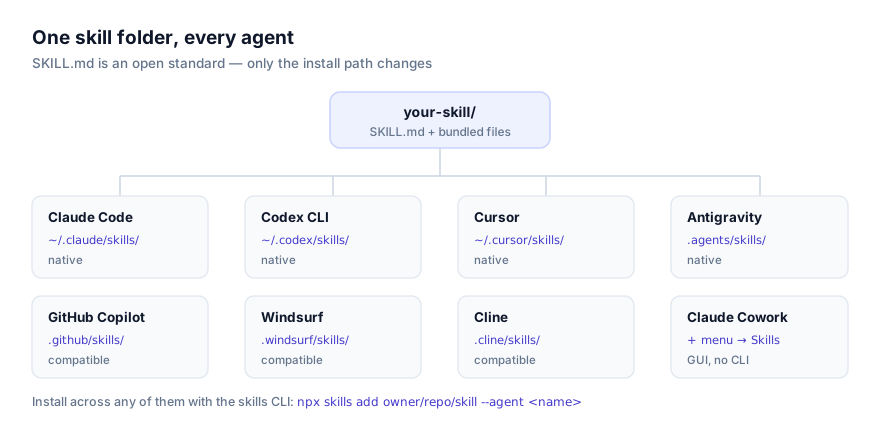
Agent Skills is read, in one form or another, by sixteen agents at this point, split roughly into two tiers.
Native support, the vendor built skill discovery and loading in as a first-class feature:
- Claude Code, Anthropic's CLI, and the reference implementation.
- Claude Desktop, skills added through Settings, no terminal required.
- Claude Cowork, Anthropic's agentic workspace, covered in detail below.
- Claude API, the same folder shipped to production agents via container upload.
- Codex CLI, OpenAI's coding CLI, reading from
~/.codex/skills. - Cursor, supported from version 2.4 onward.
- Google Antigravity, Google's agent-first IDE.
Compatible support. The same SKILL.md folder works, via the agent's own skill-loading behavior rather than a joint Anthropic integration:
- GitHub Copilot, reading from
.github/skills. - Windsurf, reading from
.windsurf/skills. - OpenCode, the open-source terminal agent.
- Cline, the VS Code autonomous coding agent.
- Roo Code, the VS Code agent fork, reading from
.roo/skills. - Goose, Block's open-source developer agent, reading from
.goose/skills. - Kiro, AWS's spec-driven agentic IDE, reading from
.kiro/skills. - Continue, the open-source IDE assistant, reading from
.continue/skills. - Trae, ByteDance's AI IDE, reading from
.trae/skills.
That's Anthropic, OpenAI, Anysphere, Google, GitHub, Cognition, SST, Cline, Roo, Block, AWS, Continue and ByteDance. Thirteen separate companies, none of whom had to ask Anthropic's permission to build support for a folder-and-markdown format they didn't invent. That's the actual significance of "open standard": not that Anthropic promised support elsewhere, but that nothing stopped anyone else from building it. The full picture, with verified install paths per agent, is on the platforms page.
Claude Cowork: the release that made 2026 different
If one thing turned 2026 into the year the ecosystem actually spread, it's Claude Cowork. Anthropic's agentic workspace for delegating multi-step knowledge work, where Claude plans and executes tasks directly on a computer: clicking, typing, opening apps, using a browser and dev tools, for jobs that don't have a purpose-built connector or tool.
Cowork is available on all paid plans (Pro, Max, Team, Enterprise) as a desktop app on macOS, Windows and Linux (in beta). The Windows desktop app landed 10 February 2026.
From desktop to everywhere
Since 7 July 2026, Cowork also runs from claude.ai in the browser and from the Claude mobile apps on iOS and Android. Sessions execute remotely in the cloud and save to your account, which means a task keeps running after you close your laptop, and a scheduled task can fire with no device online at all. That's a genuine shift from "an agent running on my machine" to "an agent running on my behalf, wherever it happens to run", and it's a large part of why skills matter more in 2026 than in 2025. A skill is portable instruction; an agent that isn't tied to one machine needs its instructions to be portable too.
Anthropic Labs plugins
On 30 January 2026, Anthropic released eleven open-source plugins for Cowork, working through MCP. That's a separate mechanism from skills (plugins connect Cowork to external systems, where skills shape how Cowork carries out a task once it's connected) but the two are frequently used together in practice: an MCP connection gets Cowork access to a system, and a skill tells it what to do once it's there.
Record a Skill: a second authoring path
Launched 21 July 2026, Record a Skill lets you screen-record yourself doing a task while narrating what you're doing and why. Claude converts that demonstration into a reusable skill it can run again without further prompting. It's found in the + menu of the Claude desktop app, under "Record a skill," and it's available on Pro, Max and Team plans. On Team and Enterprise, a recorded skill can be shared with specific colleagues or published to the whole organization's skill directory.
This matters more than it might look at first glance, and Anthropic's own usage data explains why: more than 90% of Cowork usage is non-software work, operations, finance, content. That's a population of users who were never going to hand-write YAML frontmatter and markdown instructions, no matter how simple the format actually is. Record a Skill gives them a second route into the exact same underlying artifact (a SKILL.md file) without requiring them to open a text editor at all.
Before 21 July 2026, the only way to produce a skill was to write one. Now there are two authoring paths that both terminate in the same portable file.
The cross-agent installer: skills CLI
With adoption spread across sixteen agents, each with its own install path, a plain installer became necessary rather than a nice-to-have. That's the skills CLI, maintained by Vercel Labs:
npx skills add owner/repo/skill
Target a specific agent when you have more than one installed locally:
npx skills add owner/repo/skill --agent claude-code
npx skills add owner/repo/skill --agent codex
There's no account, no registry lookup, no packaging step behind this. It resolves a GitHub location and copies (or symlinks) the folder into the right directory for the agent you named. That it's maintained by Vercel Labs rather than Anthropic is itself a small data point in favor of the standard's independence: the tool that ties the whole multi-agent ecosystem together isn't owned by the company that defined the format.
The scale of the public ecosystem
Through 2026, the registry ecosystem has grown enormously, tens of thousands of public skills, spread across thousands of GitHub repositories. That's the headline number, and it's the one most likely to get quoted uncritically. It shouldn't be, and that's where our own view of the current moment gets specific.
Our take
Our take: five things we believe are true about where this is heading, stated plainly.
1. Recorded skills and written skills are complements, not rivals. Recording wins for tacit, GUI-heavy, hard-to-articulate work. The kind of task an experienced person can demonstrate in ninety seconds but would struggle to describe accurately in prose. Hand-written SKILL.md wins wherever you need precision, code review, version control, and portability across agents that a recording alone doesn't guarantee. Teams that use Cowork seriously will end up doing both, and treating one as the "real" way to make a skill misses why both paths exist.
2. Portability is the whole point. The entire reason SKILL.md matters is that one folder runs, unmodified, on Claude Code, Codex CLI, Cursor and Antigravity, and now on nine more agents beyond those, at varying support levels. Be skeptical of anything that tries to lock a skill's usefulness to one vendor's product, whether through a proprietary extension to the format or a distribution channel that only works inside one tool. The moment a "skill" only works in one place, it's stopped being the thing that made this format worth adopting in the first place.
3. The description field is still the highest-leverage thing in the entire ecosystem. It remains the single most common reason a skill silently never fires. This hasn't changed with more platforms, more authoring paths, or more volume, if anything, it matters more now, because a badly-described skill is one more entry in an already-crowded directory that a user will never actually see triggered, no matter how good its body is.
4. Read before you run. A skill can ship executable scripts, and the ecosystem's growth through 2026 has outpaced its review culture by a wide margin. Nobody is certifying the thousands of repositories skills now live in. This is exactly why we link to source on GitHub rather than re-hosting files here, so that reading a skill before installing it stays the default habit, not an extra step people skip because the friction of finding the source was too high.
5. Volume is not quality, and this is the one that matters most right now. Tens of thousands of public skills sounds impressive stated on its own. A large share of that number is thin, duplicated, or a near-copy of something better maintained two repositories over. Availability was the scarce good in 2025, when the format was new and there wasn't much to install. It isn't scarce anymore. What's scarce now is curation: someone having actually read a skill, checked what it does, and vouched for it being worth your time and your execution permissions. A directory that just lists everything that exists is solving last year's problem. A directory that filters is solving this year's.
What this means if you're choosing where to start
If you're new to skills in the second half of 2026, the honest advice is not "go find one of the tens of thousands available." It's narrower than that: start from a specific, recurring task you actually do, check whether a well-maintained skill for it exists, browse getclaudeskills.com/skills or a relevant category rather than searching GitHub cold. Read it before installing, and be equally willing to write your own five-line skill if nothing decent turns up. The volume of what's out there is not a reason to lower your bar for what you install; if anything it's the reason to raise it.
Troubleshooting: misreadings of the current moment
"The standard just launched." No. It launched in late 2025. What's new through 2026 is the breadth of adoption, Cowork's remote and mobile reach, Record a Skill as a second authoring path, and the scale of the public catalog. Treat 2025 framing as stale.
"More platforms means more fragmentation." Mostly the opposite so far, every agent listed above reads the same SKILL.md folder, with differences confined to install paths and discovery timing (session-start versus live-watching a directory), not the format itself. Fragmentation would look like incompatible frontmatter schemas across agents; that hasn't happened.
"A skill with a lot of GitHub stars is safe to run." Popularity isn't a security review. Read the SKILL.md and anything under scripts/ regardless of how many people have installed it before you, our security guide covers exactly what to check.
"Record a Skill will replace hand-written skills." Not on current evidence. It solves for a different population (largely non-technical, Cowork-first, per Anthropic's own usage data) and a different kind of task. Precision-critical or team-shared procedural work is still better served by a written, reviewable SKILL.md.
Where to go next
For the format itself, start with What Are Agent Skills? and The SKILL.md Format Explained. If you're deciding where a given piece of instruction belongs, Agent Skills vs MCP and Agent Skills vs Subagents cover the two comparisons that come up most. And before installing anything from the numbers discussed above, read Agent Skills Security: What to Check Before You Install. It's a five-minute habit that scales a lot better than trusting a star count.