

What makes a good marketing skill
Marketing is one of the categories where a skill lives or dies on whether it actually knows your brand, not just marketing theory in general. Any agent can produce competent-sounding ad copy or a generic content calendar; the skills worth installing are the ones built to take your voice, your sales data or your offer as input, rather than defaulting to interchangeable output that could belong to any company. That's why the strongest entry on this list, Guideline Generation, isn't a content-writing skill at all. It's the thing that makes every other marketing skill's output sound like you instead of like a template.
The second thing worth checking: whether a skill produces a plan, a critique, or a finished asset. Those are different jobs, and conflating them is a common source of disappointment. A landing page audit tells you what's wrong; a marketing plan tells you what to do about it strategically; an email sequence skill writes the actual copy. Match the skill to the stage of work you're actually at.
None of this is a benchmarked or independently tested ranking. It's a curated selection based on quality, popularity and how actively maintained each skill's source repository is. If your team is mostly non-technical, the good news is that marketing is one of the more forgiving categories here: most of the skills below need nothing more than a chat interface, and our guide to agent skills for non-technical teams covers how to evaluate any skill in plain terms before you trust it.
The best marketing skills for AI agents
Ordered from most foundational to most situational. The first few are things nearly every marketing team benefits from, the later ones solve narrower, more specific problems.
Guideline Generation
Synthesises brand voice guidelines from whatever source material you have (sales call transcripts, discovery reports, existing brand documents, or direct input) into a structured style guide.
Who it's for: any team that doesn't already have a written voice-and-tone guide, or has one that's stale. Caveat: its own guidance says it's not the right fit if you want a quick, generic style guide without in-depth analysis, or if you don't have enough source material to synthesise from. It needs real inputs to work with. No special requirements listed, so it runs anywhere. From anthropics/knowledge-work-plugins, 23,000 stars, Apache-2.0 licensed.
Marketing Plan
Generates an exhaustive 13-section marketing plan structured around the AARRR framework (Acquisition, Activation, Retention, Referral, Revenue), tailored to a client or product's actual budget, team and stage.
Who it's for: fractional CMOs, agencies, and anyone building a go-to-market roadmap for a client or stakeholder audience. Caveat: its own guidance says it's not suited to generating tactical single-channel execution documents, or for people who want loose, unstructured ideas without committing to a detailed plan. It produces one specific, comprehensive artefact, not quick brainstorming. No special requirements listed. From coreyhaines31/marketingskills, 44,000 stars, MIT licensed.
Content Strategy
Pulls sales data from PayPal and QuickBooks, layers in seasonality, and produces a prioritised 30-day content brief: what to push, what offers to run, what to hold. Strategic output only, no calendars, no assets.
Who it's for: small and medium-sized business owners who want their content plan grounded in what's actually selling rather than guesswork. Caveat: its own guidance is explicit that it doesn't generate calendars or marketing assets. It's a strategic brief, and you'll need a different skill (or a person) to turn it into finished posts. No special requirements listed. From anthropics/knowledge-work-plugins, 23,000 stars, Apache-2.0.
Social Content
Covers creating, scheduling and optimising social content across LinkedIn, Twitter/X, Instagram, TikTok and Facebook, plus social listening and engagement triage.
Who it's for: marketers and business owners handling day-to-day social output across multiple platforms. Caveat: its own guidance says it's not built for in-depth paid advertising strategy or for content strategy that goes beyond social channels specifically, pair it with a broader planning skill like Marketing Plan or Content Strategy above rather than relying on it alone. No special requirements listed. From coreyhaines31/marketingskills, 44,000 stars, MIT.
Email Sequence Design
Designs and optimises multi-email flows (welcome sequences, nurture sequences, re-engagement campaigns, onboarding emails) as automated, trigger-based programs.
Who it's for: anyone running lifecycle email who wants sequences built around proven structure rather than one-off drafting. Caveat: its own guidance says it's not suited to single, standalone emails or cold outreach campaigns. It's specifically a multi-email flow tool. No special requirements listed. Same repository, coreyhaines31/marketingskills, 44,000 stars, MIT.
Landing Page Conversion Audit
Audits a landing page, sales page or checkout flow for conversion leaks and returns a fix list ordered by expected revenue impact, based on the page's URL, traffic source and conversion data.
Who it's for: anyone with a page that's getting traffic but underperforming on conversion, and wants a prioritised, evidence-based fix list rather than generic CRO advice. Caveat: its own guidance says it isn't useful on pages without traffic. It needs real performance data to diagnose against, not just a design to critique. This one requires shell access. From github/awesome-copilot, 38,000 stars, MIT.
Offer Design
Builds or improves the actual offer being sold (value framing, bonus stacking, guarantee design, scarcity and urgency, naming, payment structure) on the premise that a strong offer converts even with average copy.
Who it's for: service businesses, coaches, course creators and high-ticket B2B sellers constructing or refining what they're actually selling. Caveat: its own guidance says it's not the right fit for self-serve SaaS, where pricing tiers and packaging matter more than the kind of offer construction this skill covers. No special requirements listed. coreyhaines31/marketingskills, 44,000 stars, MIT.
Competitor Ad Intelligence
Scrapes and analyses a competitor's paid ads across platforms like Meta and Google, reverse-engineering creative patterns and landing page funnels into a structured teardown.
Who it's for: teams looking for new creative angles or trying to understand a competitor's paid growth strategy. Caveat: its own guidance says it's not for organic SEO competitor research or general website positioning analysis. It's specifically about paid advertising. No special requirements listed. github/awesome-copilot, 38,000 stars, MIT.
Attribution
Helps interpret and choose between attribution models (first-touch versus last-touch, multi-touch, media mix modeling, incrementality) and reconcile conflicting numbers when your ad platforms and analytics tools disagree.
Who it's for: marketers trying to figure out which channels actually drive revenue when the dashboards don't agree with each other. Caveat: its own guidance says it assumes tracking is already in place. It's not for general event tracking setup or configuring ad-platform pixels from scratch. No special requirements listed. coreyhaines31/marketingskills, 44,000 stars, MIT.
Marketing Council
Simulates a board of advisors staffed by well-known marketing thinkers (Seth Godin, David Ogilvy, Eugene Schwartz, April Dunford, Rory Sutherland, Alex Hormozi, Byron Sharp and others) grounded in their documented frameworks, and deliberately surfaces disagreement between them rather than flattening it into one answer.
Who it's for: anyone who wants multiple, genuinely different perspectives on a specific marketing decision before committing to one. Caveat: its own guidance says it's not suited to straightforward tasks that don't need multiple viewpoints, for a routine piece of copy, it's more process than the task warrants. No special requirements listed. coreyhaines31/marketingskills, 44,000 stars, MIT.
How to evaluate a marketing skill before you trust it with a real campaign
The checklist doesn't change much from category to category, but it's worth spelling out for marketing specifically, since the cost of a bad output here is public, a tone-deaf email sequence or an off-brand social post goes out to real customers, not just into an internal document.
- Read the description before you install anything. It's the only thing the agent sees before deciding a skill applies, and it's also the fastest way to judge whether the author actually understood the marketing problem or wrote something generic. A description that names a specific situation ("when a user asks what to post this month") is a better sign than one that just says "helps with marketing."
- Open the skill's source on GitHub before you run it. Every skill linked in this article goes to its code rather than a re-hosted copy, specifically so you can read the instructions before trusting them. You don't need to be technical to do this. A
SKILL.mdfile is plain markdown, readable top to bottom. - Check what data or context the skill assumes. Content Strategy expects PayPal and QuickBooks data; Landing Page Conversion Audit expects real traffic numbers to diagnose against. A skill that assumes inputs you don't have will either underperform or ask you for them. Either way, know that going in.
- Run it once on something low-stakes. Before pointing Email Sequence Design at your actual customer list or Competitor Ad Intelligence at a live campaign, try it on a smaller, lower-risk version of the same task first.
- Treat every draft as a draft. None of the ten skills above are built to publish unsupervised. A human should read anything customer-facing before it goes out, the same way you'd review a new hire's first piece of copy.
Common failure modes with marketing skills
- Output that reads generically. Almost always means Guideline Generation (or an equivalent brand voice source) hasn't been installed or referenced yet, every content-producing skill on this list works better with an explicit style reference to draw from.
- A skill that needs data you haven't given it. Content Strategy expects PayPal and QuickBooks sales data; Landing Page Conversion Audit expects real traffic numbers. If the output feels thin or hedged, check whether the skill actually had the inputs its description assumes.
- The skill doesn't activate on a natural request. Try phrasing closer to the trigger language on the skill's own listing page, "audit my landing page" activates Landing Page Conversion Audit reliably; "look at my page" might not.
- Treating a strategic output as a finished asset. Marketing Plan and Content Strategy are explicitly strategy documents, not campaigns ready to ship. Read each skill's scope before assuming it produces something publishable.
- Assuming one skill replaces the whole function. Even the broadest skill here, Marketing Plan, produces a document. It doesn't run your marketing team. Skills are leverage for a person doing the work, not a substitute for one.
How to install these skills
Every skill on this list installs the same way. For Guideline Generation, that's:
npx skills add anthropics/knowledge-work-plugins/guideline-generation
Add --agent claude-code or --agent codex to target a specific agent, or drop the folder manually into the right directory for your setup. The full walkthroughs for installing skills in Claude Code and installing skills in Codex CLI cover both approaches, including where personal versus project-scoped skills live on disk:
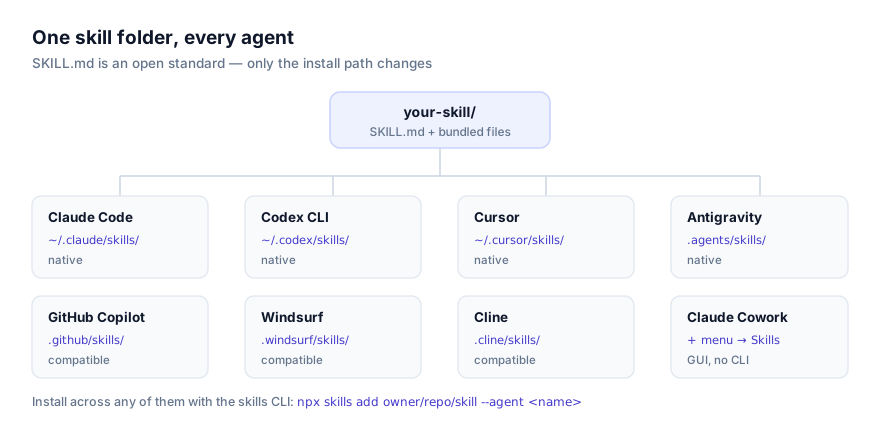
If your team runs mostly in Claude Cowork rather than a terminal, skills add the same way through the + menu, no command line required, and our guide for non-technical teams walks through evaluating a skill before installing it without needing to read code.
Combining these skills into a real workflow
A realistic sequence for a small marketing team: run Guideline Generation once to establish a voice guide, then Marketing Plan to set the quarter's strategic direction, then Content Strategy monthly to turn sales data into a prioritised brief, and Social Content or Email Sequence Design to execute against that brief day to day. Landing Page Conversion Audit and Competitor Ad Intelligence sit apart from that pipeline. They're diagnostic tools you reach for when something specific isn't working, not steps in a standing workflow.
Because skills only load their full instructions when a request matches their description, there's no real cost to installing several at once. The agent isn't running all ten every time, just picking the right one per request. If your business doesn't map cleanly onto any of these (a niche vertical, an unusual sales motion), it's worth reading how to write your own agent skill. A skill this specific to your business is rarely going to exist pre-built, and encoding your own playbook once tends to pay off fast.
Start from the marketing category page for the current full listing, or browse all skills for adjacent categories like copywriting and content writing.